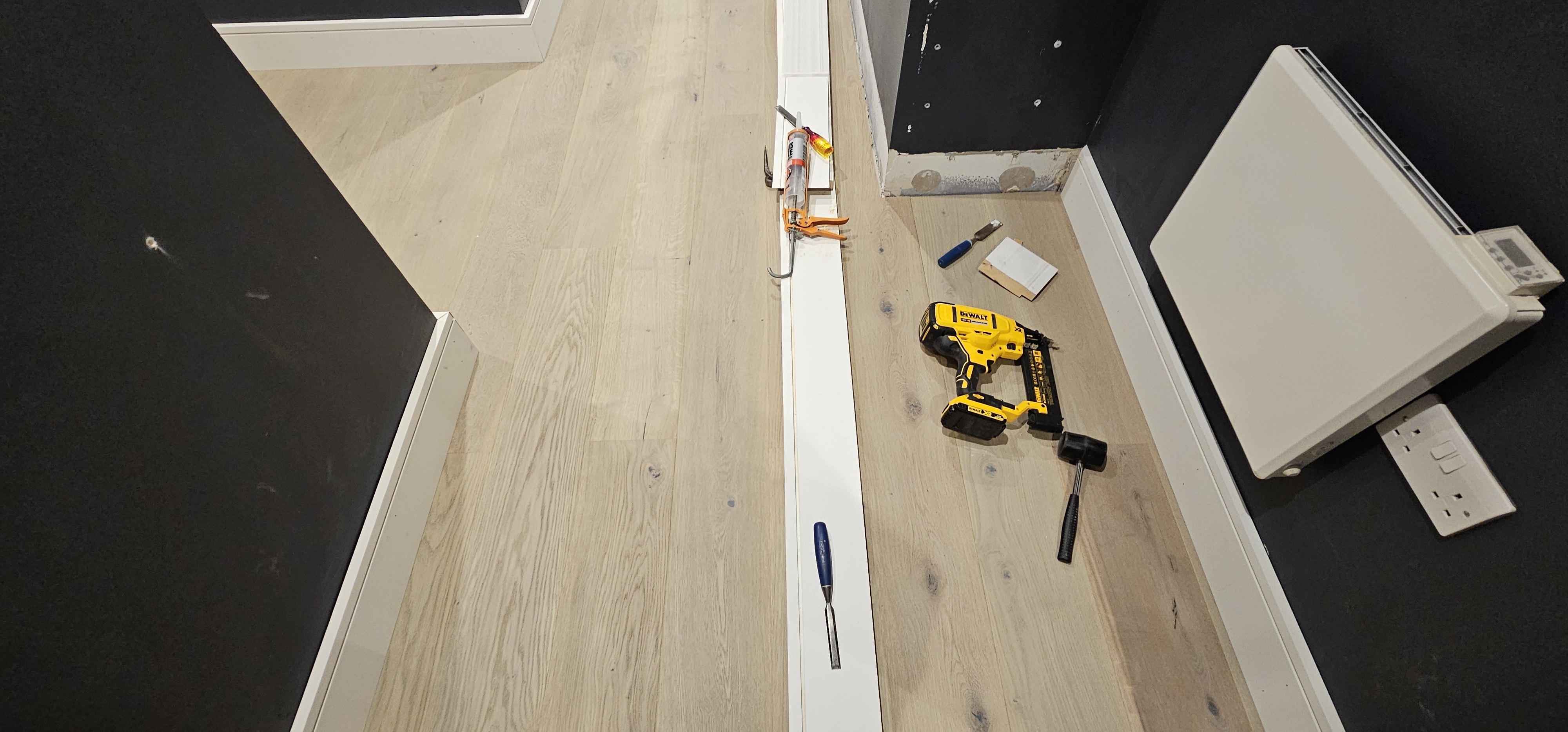
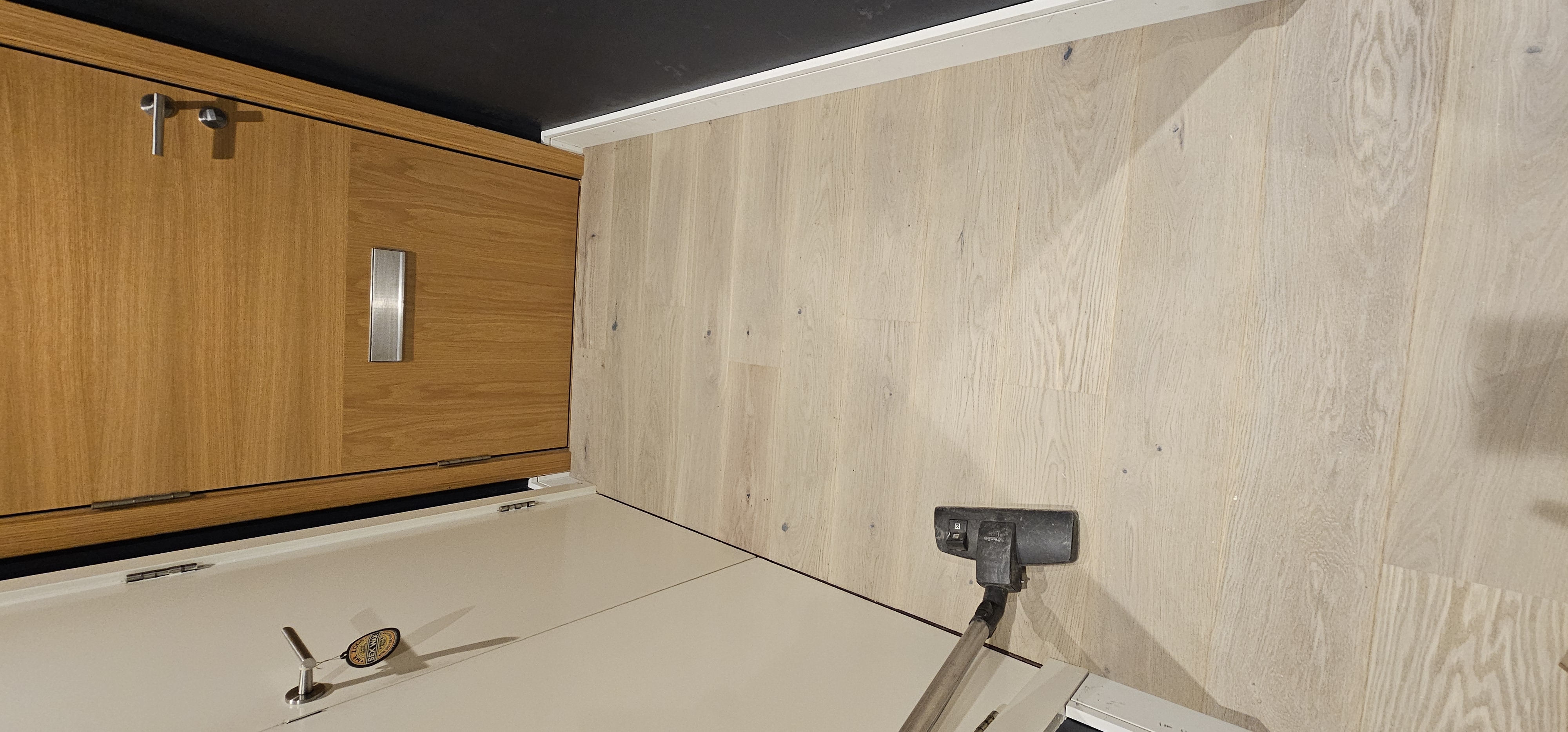
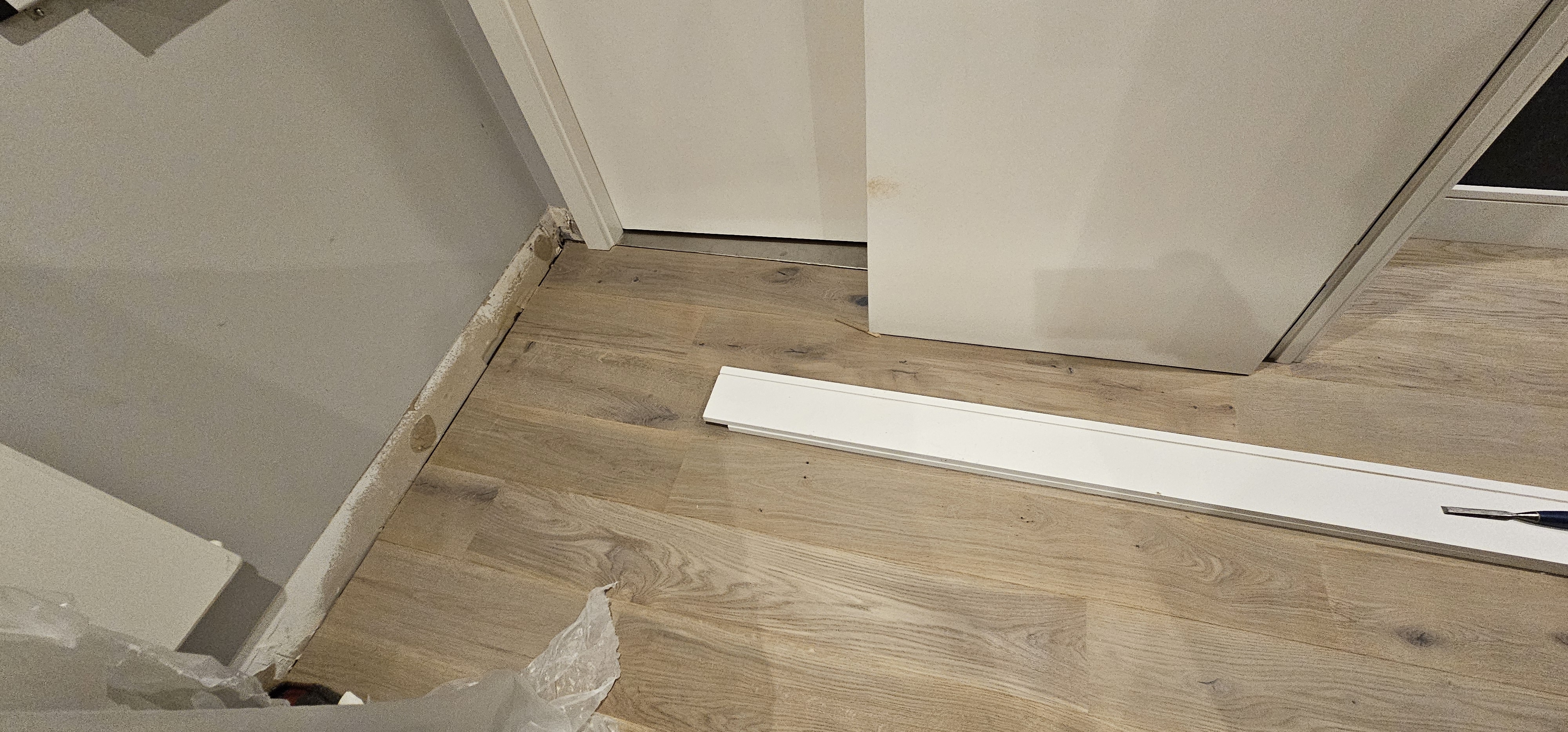
This Victorian warehouse conversion in Wapping required engineered flooring installation across 280 square metres of open-plan living and workspace. The client needed a durable, visually cohesive floor that would complement the building's original brick and timber features while performing well under moderate foot traffic. We fitted premium engineered oak throughout the main areas, choosing a natural matte finish that suited the industrial aesthetic.
Work carried out
- Site survey and floor preparation assessment
- Concrete subfloor pH testing and moisture readings
- Self-levelling compound application where required
- Engineered oak plank installation using fixed nail-down method
- Perimeter expansion gap management and timber beading
- Sanding and finishing of transition areas
- Final quality inspection and walk-through
About the project
The warehouse had been stripped back to its original concrete slab, which presented both opportunity and challenge. We tested the moisture content across multiple points and found readings between 3 and 4.8 percent, within acceptable limits but requiring careful monitoring given the building's proximity to the Thames. The concrete itself was uneven in places, with variations of up to 8mm across the main room. Rather than remove and re-pour, we applied self-levelling compound in targeted zones, which saved time and cost while ensuring the engineered boards would sit flush and stable.
The installation took six working days. We used a fixed nail-down approach rather than floating because the client wanted maximum stability for their workspace area, where heavy furniture and equipment would be placed. We left a 12mm expansion gap around all perimeters and under door frames, then finished with timber beading that tied in with the room's original skirtings. The matte finish was applied on site, sealed with a hard-wearing polyurethane that can handle the light commercial use the space receives.
About our Wapping, E1W service
Wapping has seen significant development over the past two decades, mixing Victorian and Edwardian warehouse conversions with newer apartment blocks. Most of the Victorian properties have solid timber floors that either need restoration or replacement, while the Edwardian buildings often have softer timber that performs differently under sanding. The newer developments tend to have concrete slabs with damp membranes, which require different preparation methods. We've worked on dozens of projects across all three property types in the area, so we understand the specific challenges each era presents.
The neighbourhood's location near the river means moisture is always a consideration, particularly in basements and ground-floor conversions. We specify moisture barriers and vapour control layers as standard for any project within 200 metres of the water. Many clients in Wapping are looking for industrial-style finishes that complement exposed brick and steel beams, so engineered flooring with matte or natural oil finishes is popular. We typically recommend harder wearing species like oak or walnut for these properties, since they handle the aesthetic while delivering practical durability.
Frequently asked questions
How much does engineered flooring fitting cost per square metre in Wapping?
Fitting rates typically fall between £35 and £60 per square metre, depending on the floor condition, the method used (floating versus fixed), and site access. A concrete slab in good condition costs less than a timber floor that needs partial removal or levelling. For the Wapping warehouse project, the cost came in at £47 per square metre including preparation, which was on the higher side due to the levelling compound work required.
What preparation does the subfloor need before fitting can begin?
We always conduct a full survey first, testing moisture levels on concrete and checking timber floors for movement, rot, or significant cupping. Any high spots are sanded down and low spots filled with self-levelling compound. Existing flooring is removed if necessary. Subfloors must be clean, dry, and level within 3mm across any 2-metre straightedge. In Wapping properties near the river, we often need to install or improve moisture barriers before fitting proceeds.
How long does a typical fitting project take?
A straightforward fitting job on a prepared concrete subfloor usually takes two to three days for a 100-square-metre space. The Wapping project ran six days due to the levelling work and the size involved. Timber subfloors can be faster if they're in good condition but slower if they need repair. We always account for movement time between floors on multi-storey conversions, and weather can affect curing times for adhesives and sealers.